

AI Legal Research
AI Legal Research searches for specific laws, calculates tax scenarios, explores filing procedures and conducts full legal research, all from a conversational prompt.
Whether you need a quick VAT breakdown, step-by-step litigation guidance or an in-depth IP research paper, the AI returns structured, jurisdiction-aware answers backed by trusted legal sources. Research threads persist, so returning to a question weeks later keeps the sources and the reasoning that produced the first answer.
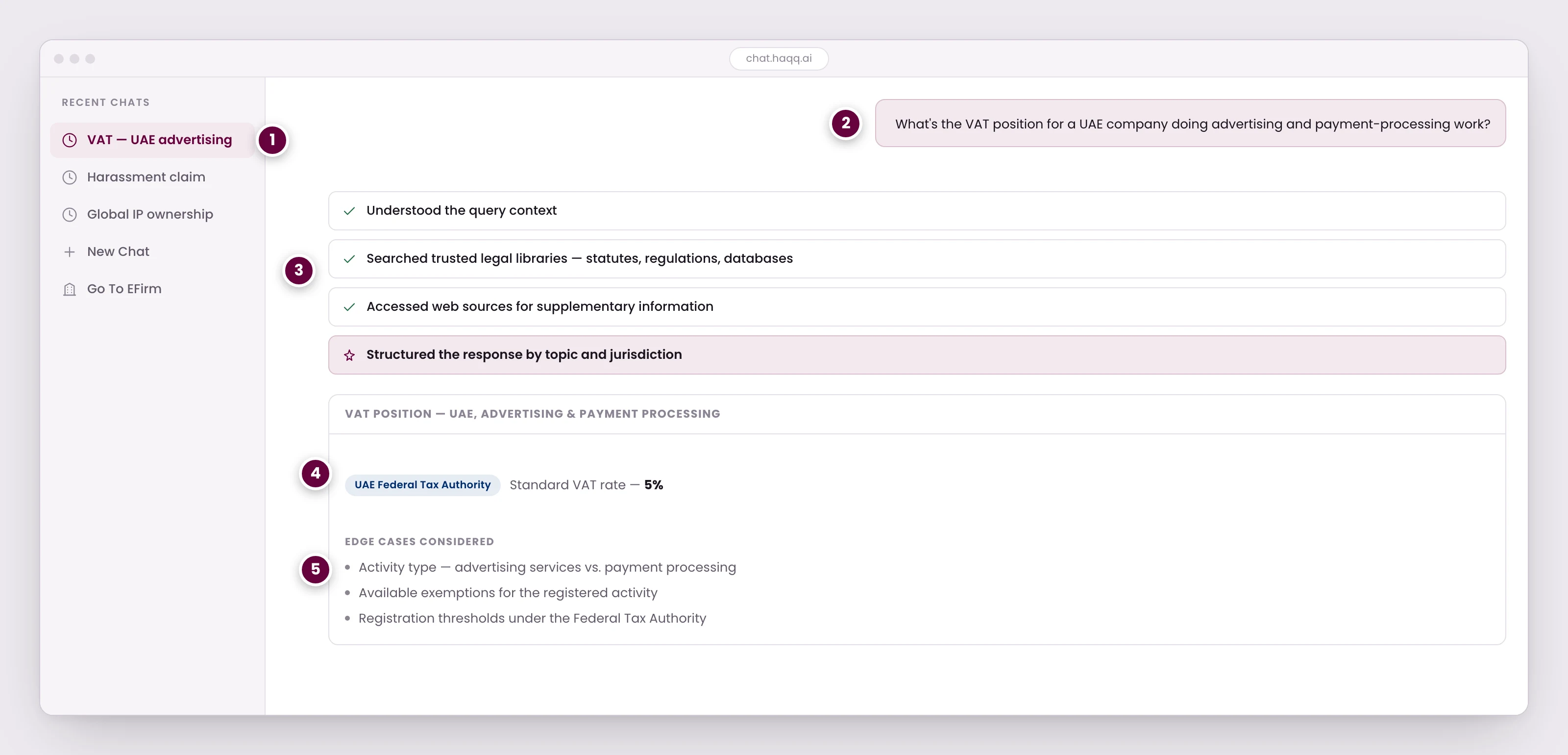
- Research threads persist. Returning to a question weeks later keeps the sources and the reasoning that produced the first answer.
- A question in plain language, not a search query. Jurisdiction and activity type are enough for the AI to scope the answer.
- The AI narrates its process before it answers: what it understood, which trusted libraries it searched, and what it pulled from the open web.
- The authority the answer rests on, named up front so it can be checked rather than taken on trust.
- The edge cases it considered but did not assume away. This is where a research answer becomes usable, because it tells you what still needs confirming.
Briefing the question
Research is the narrowest thing the AI does. It is a fraction of what it is built for, and it is the part where a vague question costs you the most. The fix is not a longer prompt. It is naming the four things that decide the answer: the governing law, the instrument or statute in play, the specific question, and the jurisdiction.
Always name the jurisdiction. A legal question without a jurisdiction has no single right answer, and this is the most common reason a research result comes back generic. Close every research prompt with the governing law.
| Prompt | |
|---|---|
| Thin | Can a creditor force a company into bankruptcy over an unpaid debt? |
| Briefed | A commercial company has failed to settle a commercial debt due and owing. Is that sufficient grounds to file a bankruptcy claim against the company, and what are the conditions? Under Lebanese law. |
The second version names the parties, the state of the debt, the relief sought and the governing law, so the answer comes back as conditions to satisfy rather than a description of bankruptcy.
When you already know the statute, cite it
If the question turns on a specific instrument, put it in the prompt. Quoting the law number, its year and the operative provision moves the AI off general principle and onto the text you actually need construed.
What a research answer looks like
A briefed research question comes back in a consistent shape, and knowing it tells you where to read first:
- The governing conditions the law requires before the claim stands up.
- The documents and evidence you will need to satisfy them.
- The practical outcome, branched by circumstance. One route where the debt is undisputed and a single creditor is pursuing it, another where it is contested.
It errs toward giving you more than the question strictly asked, on the reasoning that a missing angle costs you more than a surplus one. Read it and cut what the matter does not need. Practitioners routinely strike parts back out rather than commit to ground they are not solid on.
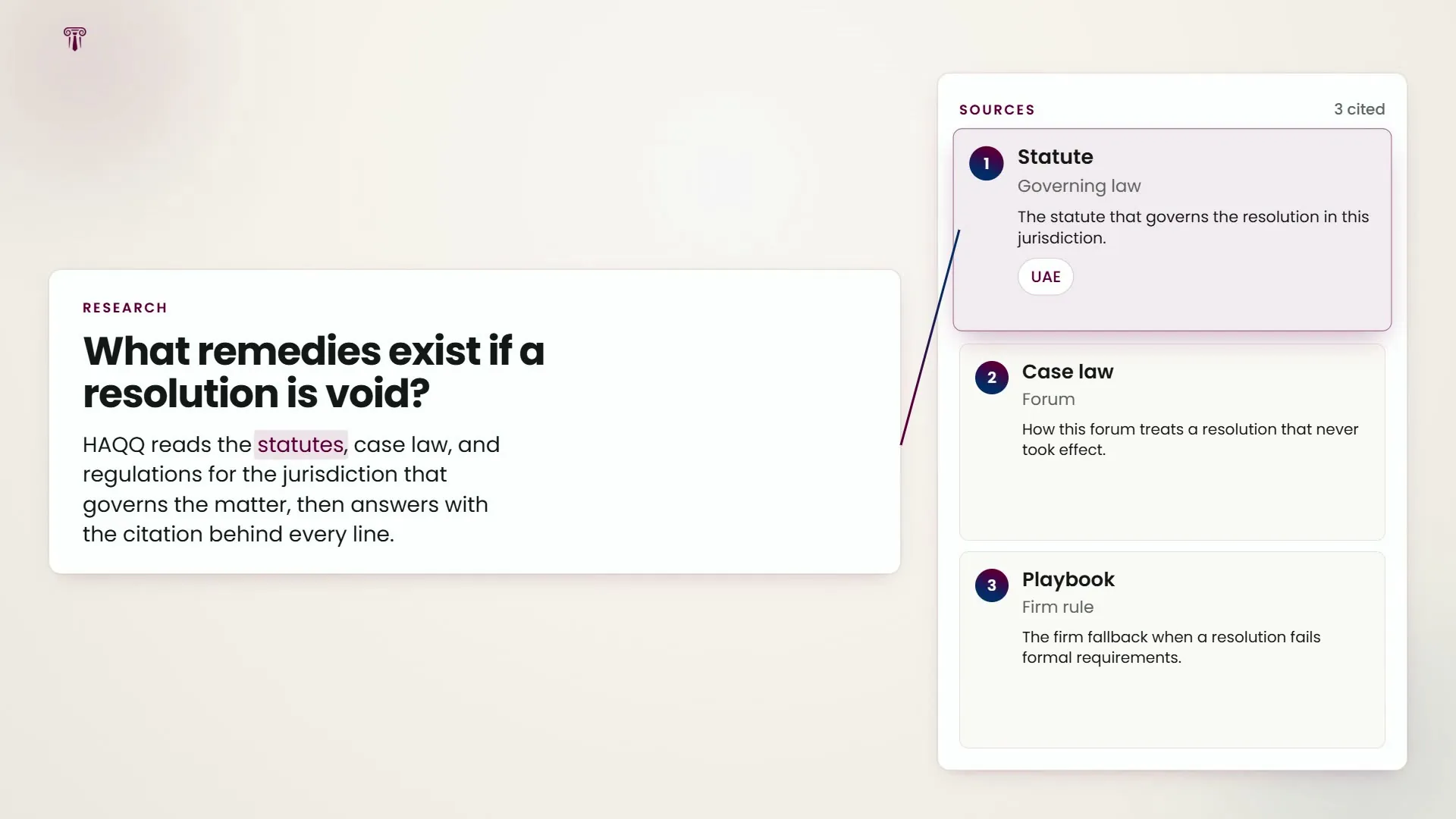
The authority the answer rests on is named up front so it can be checked rather than taken on trust, and the edge cases the AI considered but did not assume away are listed with it. That second part is where a research answer becomes usable, because it tells you what still needs confirming.
How AI Legal Research works
Every research query follows the same process, and the AI narrates it before it answers, covering what it understood, which trusted libraries it searched, and what it pulled from the open web.
- Understands your query: what law, what jurisdiction, what context you need.
- Searches trusted legal libraries, including statutes, regulations and jurisdictional databases.
- Accesses web sources, including specific legal websites and public databases for supplementary information.
- Structures the response, organised by topic, jurisdiction or procedure, depending on the query type.
Which sources the AI is allowed to reach depends on your plan and on the Contexts you enable for the session. See Subscription plans and the Legal AI overview.
Worked examples
VAT law research (a UAE example)
A VAT law search was run for UAE-based companies involved in advertising and payment processing. The AI could not identify the specific parties, so it analysed the activities instead.
The result: a detailed breakdown of VAT scenarios, starting with the standard 5% rate, then branching into every edge case based on activity type, exemptions and registration thresholds. Where precision matters, it also sets out what information it would need to determine the exact VAT number and rate.
Filing a lawsuit (step-by-step guidance)
The AI can walk you through legal procedure. A query about filing a sexual harassment lawsuit produced:
- The legal basis and applicable matter
- Step-by-step filing procedures
- An assessment of winning chances
- Everything the relevant authority (DMA) would need
It structures the response the way a practising lawyer would: identify the legal framework first, then walk through the practical steps.
Global IP research (a full legal paper)
For more complex queries, the AI produces full-length research papers. A request for global IP best practices returned:
- Access to specific laws and legal databases
- Analysis of key standards and typical IP ownership structures
- Jurisdiction-by-jurisdiction comparison
- A complete paper covering every IP aspect, ready for meeting preparation
It does not only summarise. It reaches specific websites, legal databases and jurisdictional sources to produce a structured document.
Use cases
- Tax law research, including VAT, corporate tax and withholding rules by jurisdiction
- Litigation guidance, covering filing procedures, winning assessments and required documentation
- IP research, including ownership structures, licensing best practices and jurisdictional comparisons
- Regulatory compliance, understanding requirements across different markets
- Case law analysis, finding relevant precedents and judicial interpretations
Why it matters
HAQQ's legal research is powered by the Justinian AI engine, purpose-built for legal work. It reaches trusted legal libraries and jurisdictional databases that generic AI tools do not have.
A high-level query produces actionable research. A detailed query from a practising lawyer produces a full legal brief, ready for client meetings or case preparation.
Where to go next
AI Drafting · AI Document Review · Prompt Library · AI Settings